 Pancakeswap
Pancakeswap liquidity pools change token holdings as trades move pool prices
Pancakeswap liquidity pools supply tokens for swaps and expose liquidity providers to changes in their deposited token balances. V2 spreads liquidity across the full price curve; V3 and Infinity concentrated-liquidity pools use selected ranges. Trading fees reward liquidity that swaps actually use, while eligible farms offer separate incentives. A position can gain value and still underperform holding its original tokens. Evaluating its outcome requires the remaining token amounts, collected and uncollected fees, rewards, and transaction costs.
Match Deposits to the Pool Configuration
A wallet-funded EVM liquidity deposit requires the correct network, compatible token contracts, sufficient balances, and native currency for transaction costs. EVM means Ethereum Virtual Machine. EVM V3 does not support fee-on-transfer or rebasing tokens; depositing them can leave assets stuck in the position. An existing V2 pool accepts deposits in its reserve ratio. V3 calculates the required token mix from the selected range and pool price. Its deposit amounts need not have equal fiat values. A range outside the price can accept a single underlying token.
The deposit preview identifies the pool version, token amounts, fee setting, and any range boundaries. Token approval grants spending permission. Successful execution of the liquidity transaction, together with the resulting position record or liquidity provider (LP) token balance, establishes the deposit.
Where supported, Zap swaps supplied tokens into the mix that the position requires. Its preview distinguishes swap impact, deposit impact, leftover funds, and its service fee. This funding method adds conversion costs without removing the position's exposure to later price changes.
Reserves and the Changing Token Mix
V2 uses a constant-product automated market maker, or AMM, whose pricing relationship links the quantities of the paired tokens. Ignoring fee growth, its reserves follow x multiplied by y equals k. Trades remove one token and add the other. Arbitrage trades can bring the pool price closer to prices elsewhere, changing the assets that its liquidity shares represent.
The token that appreciates relative to its counterpart generally becomes scarcer in the pool as traders purchase it. Before fee growth, providers retain less of that token and more of its counterpart than their original deposit contained. Fees can increase the assets backing their share, but the share does not preserve the original token quantities. This distinction becomes visible in withdrawal amounts even when the LP token count stays unchanged.
Impermanent Loss and the Holding Benchmark
Impermanent loss measures a liquidity position's value shortfall against keeping the same original tokens outside the pool. Both sides must use the same valuation time and unit. Comparing the position only with its initial deposit value answers a different question: whether its value rose or fell.
A rising position value can coexist with a shortfall against holding. Falling asset prices can also reduce both portfolios while their changing token mix creates an additional difference. The comparison concerns relative performance; it does not imply that the original deposit has disappeared.
A positive fee balance does not establish that liquidity provision beat holding.
For an idealized full-range constant-product position, the price-ratio change determines divergence before fees. If that ratio returns to its starting value, the model's divergence disappears. Concentrated ranges, changing allocations, and token-specific behavior require their own treatment. Real outcomes also include fees, farming rewards, and costs. Keeping the original quantities as a benchmark prevents those separate effects from obscuring how trades changed the principal holdings.
A Price Move in a Full-Range Position
This hypothetical comparison starts with 286 units of token A and 486.2 units of token B. Its initial price is 1.7 B per A, and its later price is 2.482 B per A. It models an idealized V2-style position. Ignore fees, rewards, gas costs, rounding, and changes to the provider's pool share. Assume trades bring the pool to the later price.
Keeping the tokens in a wallet preserves their quantities. Their later value is 286 multiplied by 2.482, plus 486.2: 1196.052 units of B. Providing the same starting holdings as liquidity changes the mix. The price rises by a factor of 1.46. Constant-product rebalancing divides the A holding by the square root of 1.46 and multiplies the B holding by that square root.
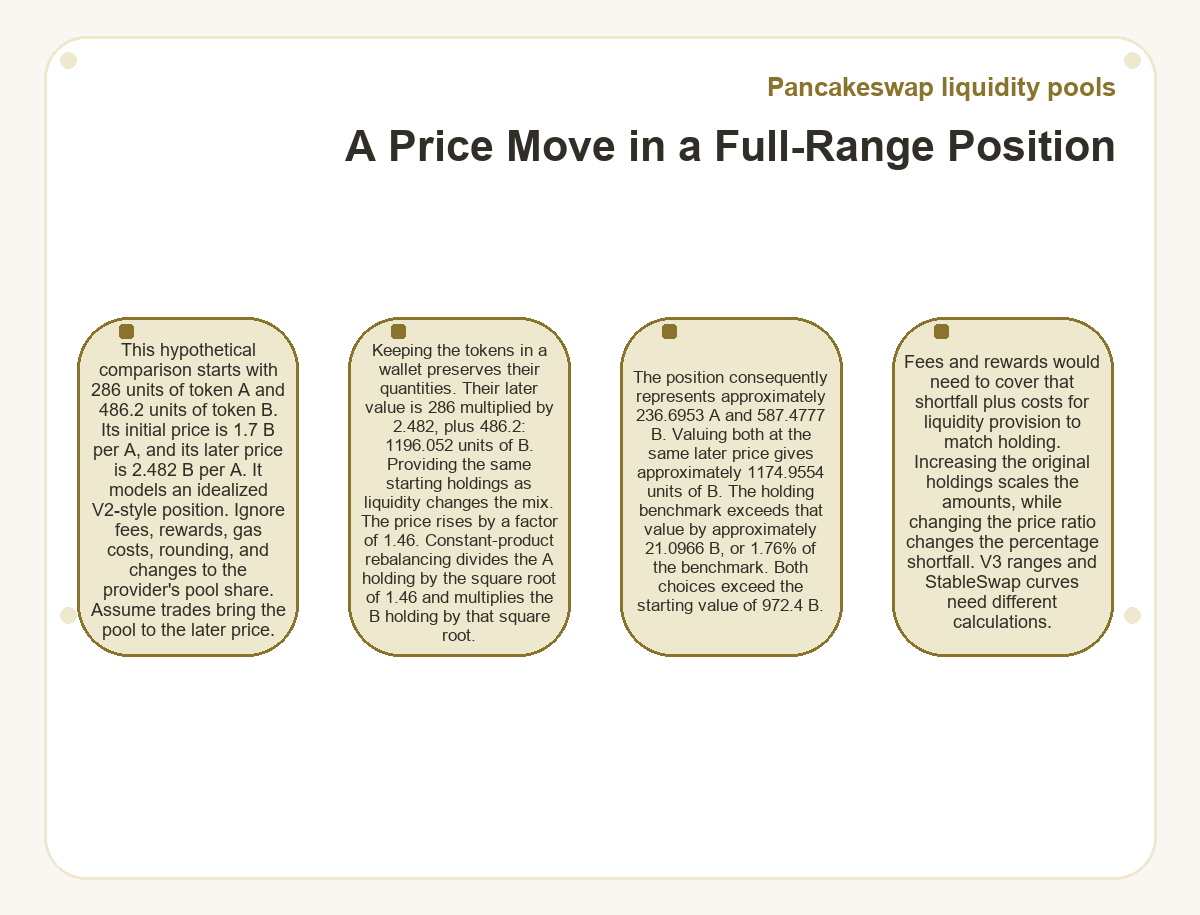
The position consequently represents approximately 236.6953 A and 587.4777 B. Valuing both at the same later price gives approximately 1174.9554 units of B. The holding benchmark exceeds that value by approximately 21.0966 B, or 1.76% of the benchmark. Both choices exceed the starting value of 972.4 B. Fees and rewards would need to cover that shortfall plus costs for liquidity provision to match holding. Increasing the original holdings scales the amounts, while changing the price ratio changes the percentage shortfall. V3 ranges and StableSwap curves need different calculations.
Range Boundaries and Inactive V3 Positions
A V3 range concentrates liquidity between chosen price boundaries, increasing the liquidity available there per unit of deposited capital. Narrowing a range around the pool price can increase the position's share of active liquidity. Bringing a boundary closer also means a smaller price move can cross it and interrupt fee earning.
An out-of-range V3 position earns no new trading fees. Its principal becomes one token from the pair, with the token determined by the direction of the move. Previously accrued fees remain distinct from that principal. If the pool price returns inside the unchanged range, the position resumes participating in swaps without a new deposit. Being inactive therefore describes a trading condition, while the position still represents its underlying assets.
Trading Fees and the Share That Earns Them
Trading fee income follows swaps that use the position's liquidity and the provider's share of eligible liquidity. A pool's fee setting describes what trades pay; the provider's allocation also depends on the protocol fee rules. A higher fee setting alone cannot establish greater income because trading volume and competing liquidity affect the amount that reaches a position.
V2 adds its provider fee allocation to pool reserves. EVM V3 accounts for earned trading fees separately from deposited liquidity, so uncollected fees do not automatically expand the position. Concentrated positions also compete with liquidity active at the traded price, making total pool value an incomplete measure of competition. Pool trading volume, fee allocation, and active liquidity explain earnings more precisely than the pair's name alone.
Farming Rewards and Position-Specific APR
An eligible farm adds reward-token income to liquidity provision; staking the position leaves its underlying price exposure in place. EVM V3 farming rewards apply to eligible staked liquidity that is in range. On Solana, an in-range V3 position accrues farming rewards during an active farm campaign without separate staking. A fee-earning position without the relevant farming participation does not automatically acquire the same reward entitlement.
Annual percentage rate, or APR, estimates a rate of income rather than the position's total change in value. V3 fee estimates use historical trading activity and position settings, while farming estimates use reward emissions and participating liquidity. Indexing delays can affect displayed data. Future volume, emissions, token prices, and range activity can alter realized earnings.
A calculator's compounding setting models reinvestment; it does not execute the collection and redeposit of EVM V3 fees or farm rewards.
Removal Proceeds and Contract Exposure
Liquidity removal returns the assets that the position represents at removal, which may differ from the original deposit quantities. A concentrated position outside its range can return principal predominantly in one underlying token. Its accumulated fees can still include both tokens. In EVM V3, reducing liquidity and collecting amounts owed are distinct contract operations, although an interface can bundle them.
A preview gives estimated proceeds before execution. The confirmed transaction and received token balances establish what reached the recipient. Removal preserves the value difference already created by trading; it does not restore the original mix. Network costs also reduce the realized outcome. Contract vulnerabilities can compromise pooled assets, and token restrictions can obstruct transfers. Those risks are separate from the price divergence calculated against holding.
V2 Shares and V3 Liquidity NFTs
V2 LP tokens are fungible claims on one pool, so balances within that same LP token contract represent interchangeable shares. A V3 non-fungible token, or NFT, identifies an individual position with its own range and liquidity amount. Equal deposit values therefore need not produce equivalent V3 positions or equal fee earnings.
V3 price boundaries use ticks, which index prices, and valid boundaries follow the pool's tick spacing. A displayed price range must therefore correspond to permitted tick boundaries. This discrete structure matters when comparing configured positions: the settings define where capital participates, while the NFT identifies which position owns that capital.
Infinity Ranges, Bins, and Hooks
Infinity supports concentrated liquidity through CLAMM and discrete price-bin liquidity through LBAMM, alongside other supported pool designs. CLAMM means concentrated liquidity automated market maker. LBAMM means liquidity book automated market maker. CLAMM allocates liquidity across a selected range; LBAMM distributes it among bins with specified prices and allocation weights.
An Infinity LBAMM swap has no curve-based price impact while it remains inside one bin. Exhausting that bin can move execution to another price level. This property does not eliminate swap fees or protect providers from changing holdings. The bin position manager represents fungible bin shares with ERC-1155-like multi-token balances, rather than V3-style position NFTs.
Infinity hooks add pool-specific logic around operations such as swaps and liquidity changes. Pools can use static or dynamic fees. A dynamic fee hook determines fees within its configured rules. Any risk-control feature depends on the specific hook implementation. The pool type and attached hook together determine behavior, so V3 fee and position assumptions do not describe every Infinity pool.
StableSwap Curves and Peg Risk
StableSwap uses a hybrid pricing curve for assets expected to trade near the same price. Classic StableSwap supports existing pools, while Infinity StableSwap on BNB Chain implements its curve through a hook with dynamic fees and adjustable amplification. Amplification controls how tightly the curve follows the peg; it does not establish that either asset will maintain its value.
Infinity StableSwap liquidity spans the curve without requiring a selected concentrated price range. Providers therefore avoid that specific out-of-range state. Peg failure remains a different risk: trading can shift pool holdings toward the weaker asset as its relative price changes. A continuously active position can consequently accumulate exposure that its fees do not offset.
Questions and answers about Pancakeswap liquidity pools
How Does Reversing the Price Display Affect a V3 Liquidity Range?
Reversing the display expresses the same range in units of the other token. The prices become reciprocals, and the lower and upper bounds exchange roles. Switching the display alone does not move capital or create a new position. Read the token named in each price unit before comparing boundaries.
Can One Wallet Hold Several V3 Positions for the Same Pair?
One wallet can hold multiple V3 positions for the same trading pair. Each position has its own identifier and configuration, including its range and liquidity amount. Different fee settings identify different pools even when the tokens match. Earnings and farming eligibility therefore belong to the particular position and pool.
Must I Unstake a V3 Position Before Reducing Its Liquidity?
The EVM V3 farm interface supports liquidity adjustments without first unstaking the position. Its adjustment flow also harvests unclaimed CAKE rewards to the wallet. This behavior applies to supported V3 farming positions; V2 LP-token staking and Infinity farming use different mechanisms, so their custody and management steps need separate treatment.
Does Transferring a V3 Liquidity NFT Include Its Uncollected Trading Fees?
Transferring a directly held V3 liquidity NFT transfers ownership of the underlying position and its accrued trading-fee rights. The recipient controls the position rather than receiving the underlying tokens immediately. Previously collected wallet balances remain outside that transfer.
When Does an Infinity LBAMM Deposit Incur a Composition Fee?
An Infinity LBAMM deposit can incur a composition fee when liquidity enters the active bin with a token ratio that differs from the bin's existing ratio. The balancing operation acts like a swap and incurs the applicable swap fee. This condition concerns active-bin composition; it is not a universal charge on every liquidity deposit.
Will a Failed EVM Liquidity Deposit Still Consume Gas?
An EVM liquidity transaction that executes and reverts still consumes gas, even though the addition does not complete. Rejecting a wallet request before broadcasting that transaction creates no on-chain execution charge for it. Earlier approvals can remain successful, so their existence does not establish that the subsequent liquidity deposit succeeded.
Where Are V2 LP Tokens Held While Their Liquidity Is Farming?
Staking V2 LP tokens places those tokens in the farm contract while the underlying assets remain in the liquidity pool. A reduced wallet LP balance can therefore reflect staking rather than withdrawn liquidity. The farm records the staked amount. Unstaking returns LP tokens; redeeming the underlying pair requires liquidity removal.
Is an Existing V3 position's Range Editable by Adding More Tokens?
Adding liquidity to an existing EVM V3 NFT increases liquidity within its stored tick boundaries. It does not replace those boundaries. Allocating capital to a different range requires a new position with that range.